Water interactions intermolecular bonding solutions
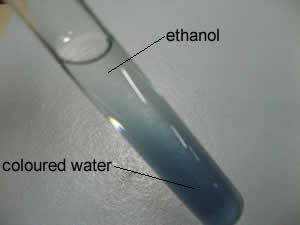
Ethanol has the structural formula CH3CH2OH . Ethanol is placed in coloured water.
What do you think will happen when the tube is shaken?
Explain why?
Ethanol and water will mix to form a single homogeneous solution (uniform colour). Ethanol has a hydroxyl ( –OH) group which is polar whilst its hydrocarbon chain is not too large to impact the interaction with water. It can form hydrogen bonds with water. Both substances have similar intermolecular forces (hydrogen bonding) hence they are completely miscible
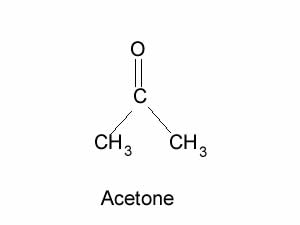
Consider the molecule of acetone shown on the right.
Is it a polar molecule?
Does it display hydrogen bonding? Explain.
Yes, acetone is polar.
Acetone has a C=O (carbonyl) group so it can form dipole-dipole interactions. However, it has no O–H or N–H bond , so it cannot hydrogen bond with itself. It is a hydrogen bond acceptor, that is to say water can hydrogen bond to the carbonyl group (C=O) only. It cannot act as a donor and therefore no self hydrogen bonding
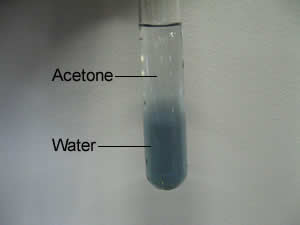
Acetone was placed in coloured water as shown on the right. Do you think it will dissolve in water? Click to see.
What can you say about the polar nature of the acetone molecule?
Yes acetone will dissolve in water.
Water can form hydrogen bonds with acetone’s oxygen atom. Strong dipole–dipole interactions + hydrogen bonding (water with acetone) leads to good solubility. Acetone is a polar molecule due to the C=O bond, but lacks tha ability to form hydrogen bonding between its own molecules.
Do you expect cyclohexane to dissolve in water? Explain
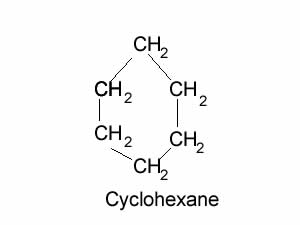
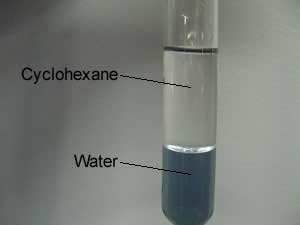
Cyclohexane is placed in water. It is left for a few minutes as shown on the right.
Explain why water and cyclohexane are immiscible?
What is the main intermolecular force of attraction in cyclohexane and water.
Which is more dense? Can you explain
Water and cyclohexane are immiscible because water has strong hydrogen bonding whilst cyclohexane has weak dispersion forces only. Water prefers bonding to itself rather than cyclohexane which causes layers to form.
.
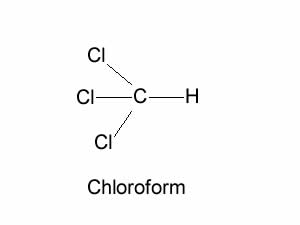
Chloroform is shown on the right.
Is it a polar molecule?
Will it dissolve in water?
Chloroform is weakly polar
It has polar C-Cl bonds and its shape is asymmetrical. This leads to very small net dipoles. However, as can be seen from the image, the dipoles are not strong enough to interact with the strong H-bonding of water and as such the two liquids are immiscible.
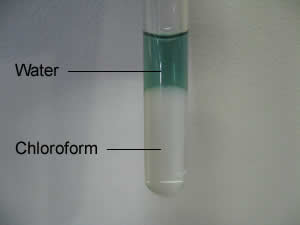
Chlorofrom is placed in water and left for a few minutes, as shown on the right.
Explain why chloroform, being a polar molecule, is not soluble in water?
Is chloroform is polar, but weakly polar. It will dissolve in water only slightly because it cannot form strong hydrogen bonds with water. Water has a strong internal hydrogen-bond network where water-water interactions are stronger than wate- chloroform interactions hence giving limited solubility.
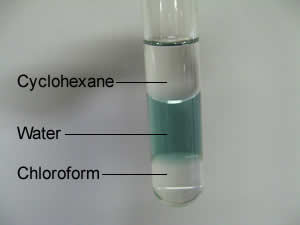
The substances water, chloroform and cyclohexane were mixed together and left for a few minutes as shown on the right.
Water is the smallest molecule out of the three with a molecular mass of 18. Cyclohexane is the next largest molecule with a molecular mass of 84 and chloroform the largest with a molecular mass of close to 119. You would expect that water would float on top of cyclohexane with chloroform at the bottom, as is the case with the latter. Give a possible explanation.
Substances separate because they are immiscible due to different intermolecular forces.
Density then determines layer order